Generalized uncertainty relation and its use in cosmology
01 Sep 2023This article is based on my Bachelor’s thesis1 in mathematical physics. I outline the main ideas and motivations of the work in broader terms. In the thesis, I investigate how deformations of the standard uncertainty relations can be interpreted, at the classical level, as deformations of the Poisson algebra of observables. I then explore how this modified structure affects Hamiltonian dynamics, with applications to geodesic motion in Schwarzschild and Kerr spacetimes and to black hole thermodynamics.
Uncertainty relations
In quantum mechanics, physical quantities such as position or momentum are represented by operators. Given two observables \(a\) and \(b\), their commutator is defined as \([a,b] = ab - ba\). If \([a,b]=0\), the observables and said to commute. Physically, this can be understood as measuring \(a\) and then \(b\) giving the same result as measuring them in the opposite order. When the commutator does not vanish, the order of measurements matters.
The uncertainty relation follows directly from this non-commutativity. For two observables \(a\) and \(b\),
\[\Delta a\, \Delta b \ge \frac{1}{2}|\langle [a,b]\rangle| .\]Here \(\Delta a\) denotes the standard deviation of the measurements of observable \(a\) and \(\langle \cdots \rangle\) is an expectation value (average of measurement values in this case of the commutator operator). In this work we assume vanishing expectation values of \(a\) and \(b\), so for instance \(\Delta a\) directly characterizes the typical size of fluctuations.
For position \(x\) and momentum \(p\), the canonical commutation relation \([x,p] = i\hbar\) leads to the familiar Heisenberg uncertainty relation
\[\Delta x\, \Delta p \ge \frac{\hbar}{2} .\]A basic physical intuition already follows from this formula: if one tries to localize a particle more and more precisely, the momentum uncertainty tends to grow.
Motivation for generalized uncertainty relations
Many theoretical frameworks suggest that the standard uncertainty relation may be modified at very short distances. These include for example numerous thought experiments, string theory, curved momentum space, noncommutative geometry, … Basis of many of these ideas is in one way or another existence of an effective minimal length scale.
A commonly studied deformation is a generalized uncertainty relation (GUP) of the form,
\[\Delta x\, \Delta p \ge \frac{\hbar}{2}\left(1 + \beta (\Delta p)^2\right) ,\]\(\beta\) being some constant of appropriate dimensions. The plot below illustrates the qualitative consequence of this relation for the case \(\beta = \ell_p^2/\hbar^2\), where \(\ell_p\) is the Planck length.
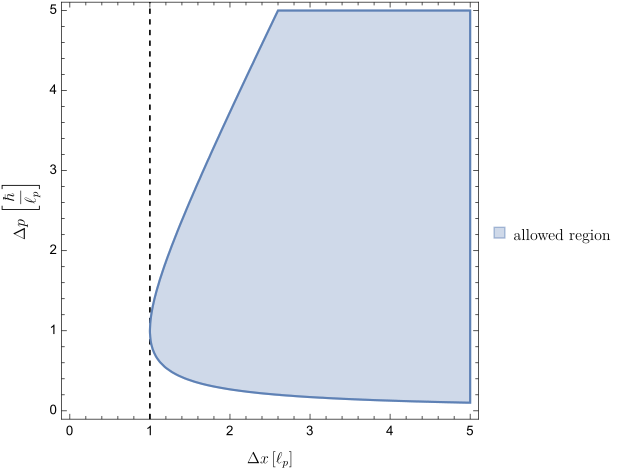
In this plot the coloured region represents the allowed values of \(\Delta x\) and \(\Delta p\). One can see that there is a minimum value of \(\Delta x\) (in this case precisely \(\ell_p\)) which can be interpreted as existence of a minimal length, below which localization is no longer possible. While the precise interpretation varies between frameworks, this qualitative feature appears very robust. For instance, similar behaviour arises in string theory due to the extended nature of strings.
Reverse quantisation and deformed algebra
In classical mechanics, observables are functions on phase space, and their algebraic structure is encoded in the Poisson bracket \(\{a,b\}\). The equations of motion then take the form
\[\dot{x} = \{x,H\}, \qquad \dot{p} = \{p,H\} ,\]where dots denote time derivatives and \(H\) is the Hamiltonian. These equations determine the trajectories of classical particles.
When one wants to promote a classical theory to a quantum one follows procedure known as quantisation. The canonical quantisation procedure is to replace Poisson brackets as
\[\{a,b\} \longrightarrow \frac{1}{i\hbar}[a,b] .\]In my thesis, I take the reverse perspective. Because commutators give us uncertainty relations, GUP motivates a deformed quantum algebra. In my work, I ask what classical structure corresponds to one such deformed algebra.
Particularly I look at the Snyder algebra2, given in the quantum theory by
\[[x^\mu,x^\nu] = -i\hbar \beta (x^\mu p^\nu - p^\mu x^\nu), \qquad [x^\mu,p_\nu] = i\hbar \left(\delta^\mu_\nu + \beta \, p_i p_j\right), \qquad [p_i,p_j] = 0 .\]Where \(x^\mu\) denotes the spacetime coordinate operators and \(p^\mu\) four-momentum operators (four-momentum combines momentum and energy). Taking the classical limit leads to a deformed Poisson algebra with the same structure. This then leads to modified Hamiltonian equations, and therefore to modified classical trajectories.
Deformed solutions of general relativity
In general relativity, the geometry of spacetime is encoded in the metric tensor \(g_{\mu\nu}\). Free test particles then follow geodesics, which can be derived using the Hamiltonian formalism.
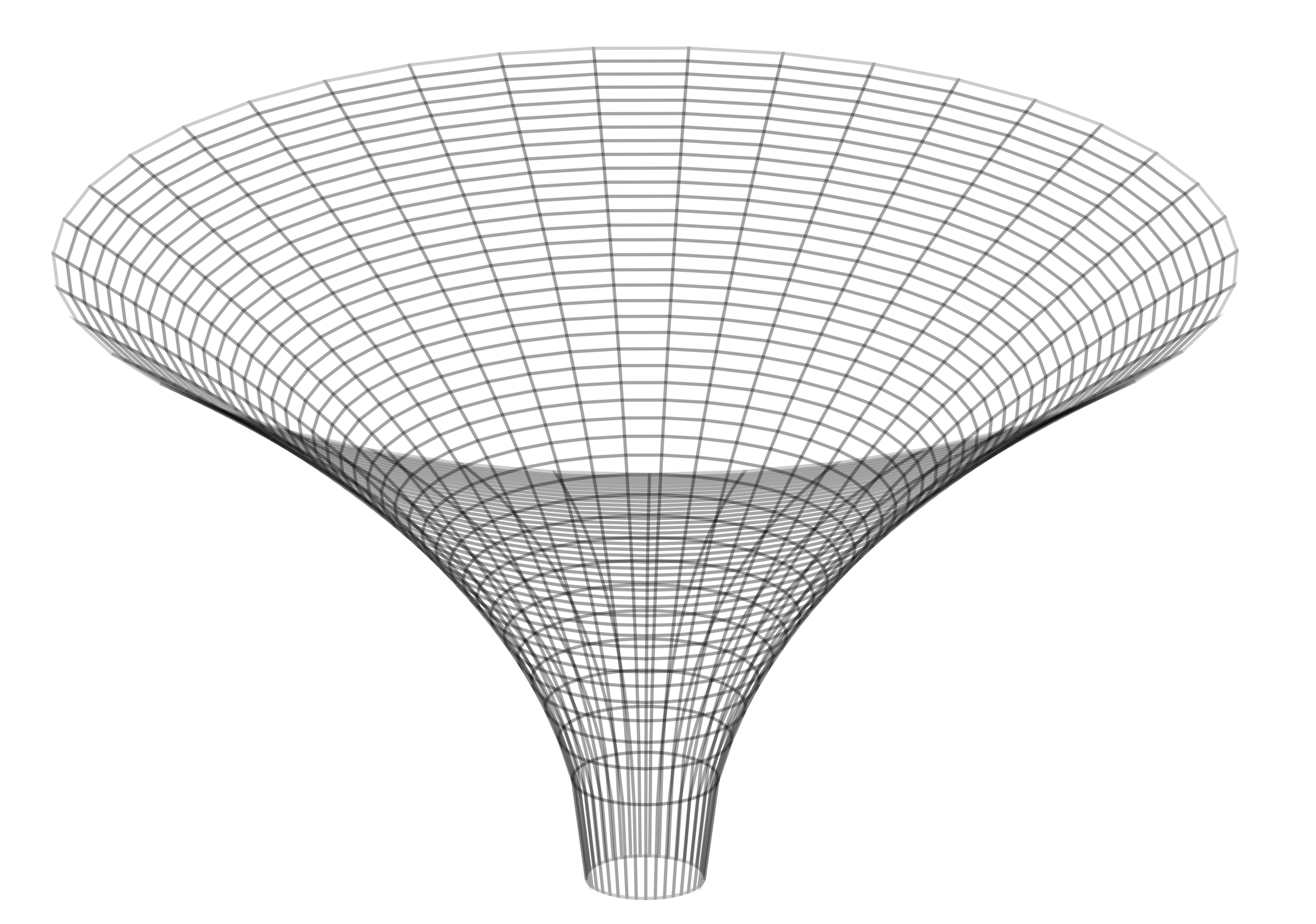
The Schwarzschild solution of general relativity for example describes the spacetime outside a spherically symmetric mass. It applies to systems like the Solar System as well as, for example non-rotating black holes. A common visualization of this spacetime provides the Flamm’s paraboloid, shown below, which represents a spatial slice in the radial direction.
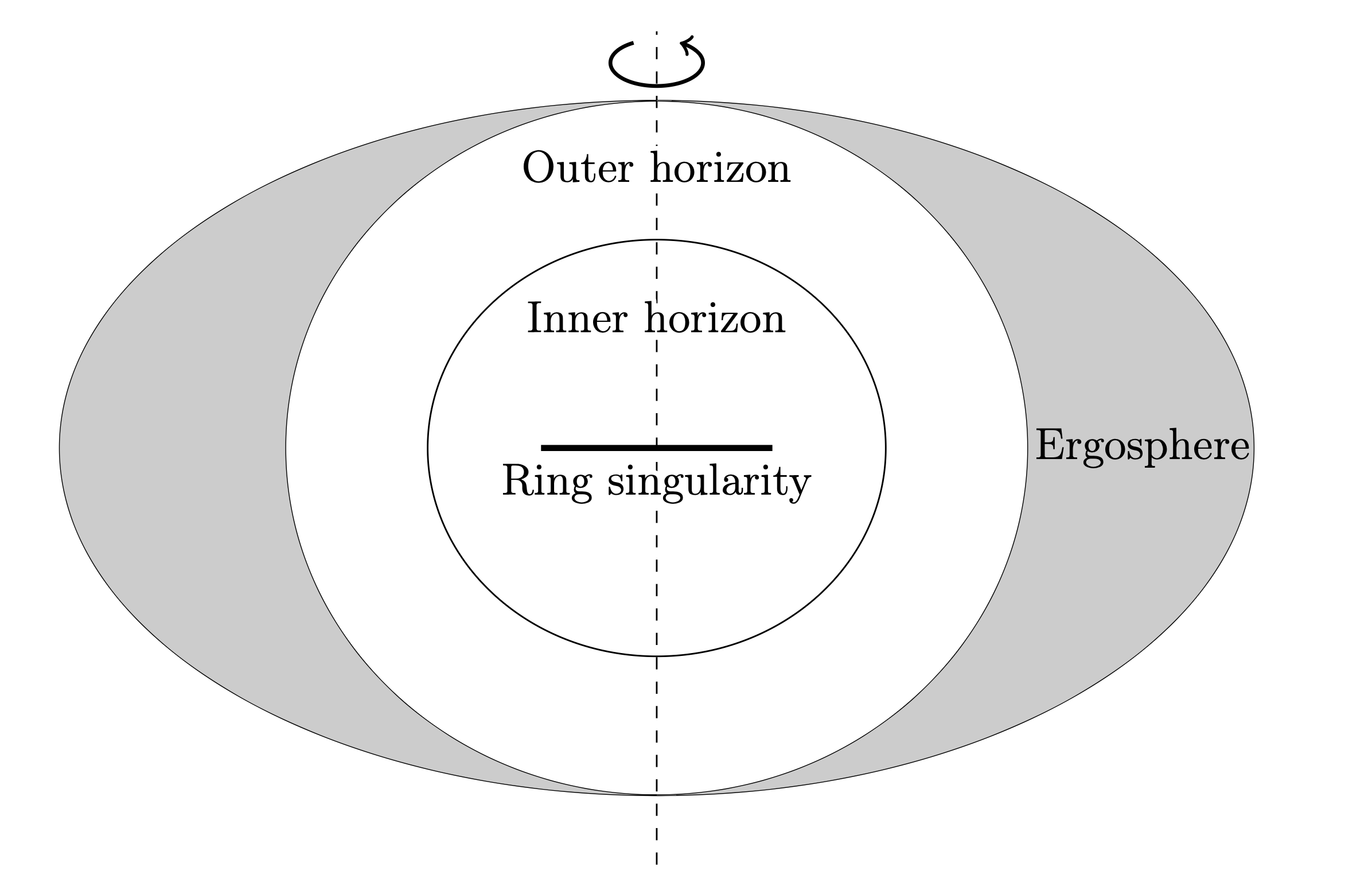
The Kerr solution generalizes this to rotating black holes (though basically just to black holes) and features additional structures such as an ergosphere and an inner horizon.
In my work, I study particle motion in both Schwarzschild and Kerr spacetimes using the pseudo-Newtonian limit. In this approximation one assumes weak gravitational field and spatial components of canonical four-momenta much smaller than the time component. Implementing the Snyder-deformed Poisson algebra in this setting then leads to modified geodesic equations and hence to deformed trajectories.
What was done and what was left out
The main contribution of the thesis is a logically consistent implementation of a deformation motivated by GUP, together with its application to geodesic motion in curved spacetimes within a pseudo-Newtonian approximation. While similar deformations of Schwarzschild geodesics have been studied before3, the approach taken here differs both conceptually and technically.
Many aspects were left out of this short overview. The thesis1 contains for example extended discussion on the motivations of such deformation and explicit calculations of the modified equations of motion. At the end applications of GUP to black hole thermodynamics are also discussed. Interested readers can find all details in the full text.
1: J. Masák, Generalized uncertainty relation and its use in cosmology, Bachelor’s thesis, Faculty of Nuclear Sciences and Physical Engineering, Czech Technical University in Prague (2023), dspace.cvut.cz/handle/10467/111416.
2: H. S. Snyder, Quantized Space-Time, Physical Review 71 (1947), 38–41, doi:10.1103/PhysRev.71.38.
3: S. Mignemi and R. Strajn, Geodesics in the Schwarzschild metric with Snyder dynamics, Phys. Rev. D 90, 044019 (2014), doi:10.1103/PhysRevD.90.044019.